Living things (organisms) are broken down into groups with similar traits. This is called, Biological Classification. Biological classification begins with big, general groups and gets smaller and more specific as they are broken down further. *There are eight levels at this time:
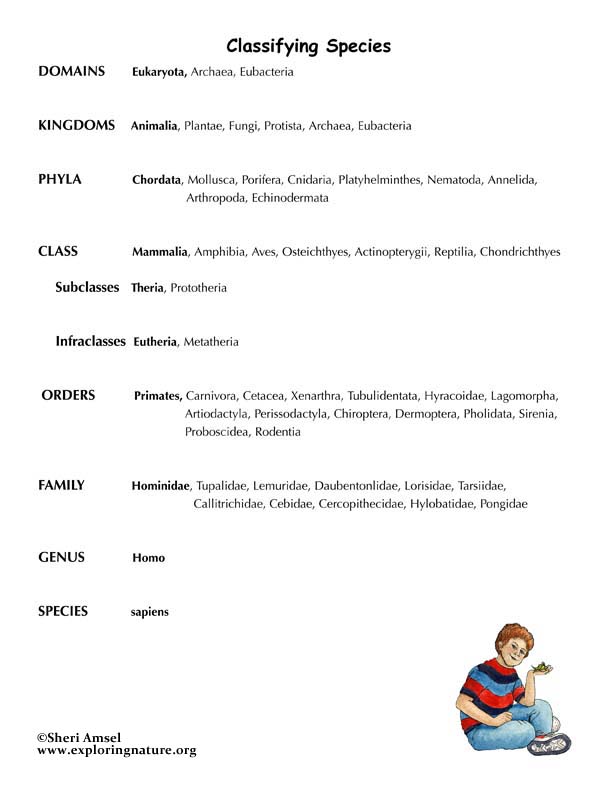
Domain (Super-Kingdom)
Kingdom
Phylum
Class
Order
Family
Genus
Species
Domain
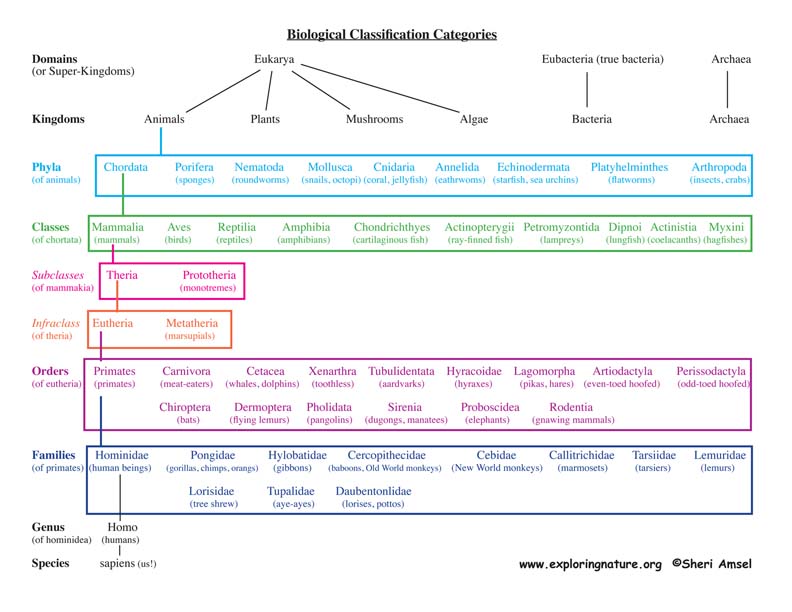
The DOMAIN is the highest ranking of Biological classification at this time* and includes 3 Domains: Archaea, Eubacteria and Eukaryota. We belong to the Domain Eukaryota – which includes organisms with cells that contain a nucleus.
Kingdom
For many years there were 5 Kingdoms: Animalia, Plantae, Fungi, Protista, and Monera (you will still see these in most printed books). However, with the adoption of the Domain Level the present 4 Kingdoms are as follows: Animalia, Plantae, Fungi, Protista. (Protista, which includes plant-like algae, animal-like protozoans and fungi-like slime molds may well be broken up into different groups in years to come.)
Phylum
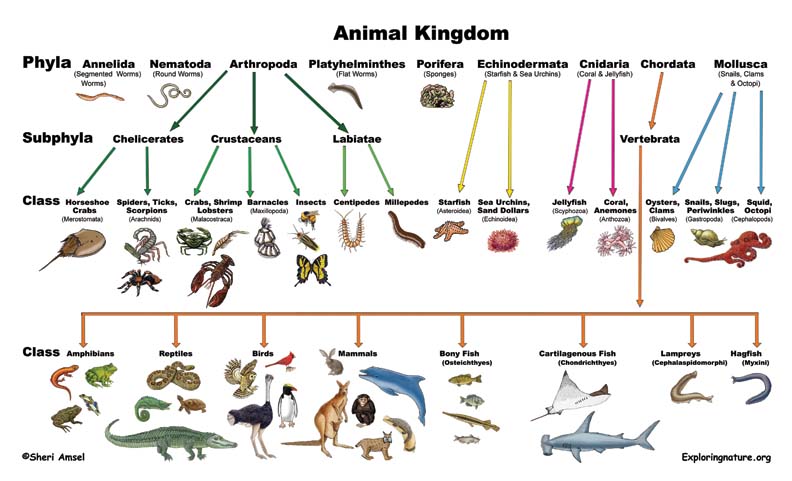
Next come the PHYLA (plural of phylum). The Kingdom Animalia currently has 9 Phyla:
• Chordata (Chordates – mammals, reptiles, birds, amphibians, etc):
• Mollusca (Mollusks – snails, octopus, & clams),
• Porifera (Sponges),
• Cnidaria (Corals & Jellyfish),
• Platyhelminthes (Flatworms),
• Nematoda (Roundworms),
• Annelida (Segmented Worms – earthworms & leeches),
• Arthropoda (Arthropods – insects, spiders, crabs, centipedes & millipedes),
• Echinodermata (Echinoderms – starfish, sea urchins, & sea cucumbers)
Class
Next comes CLASS. The Phylum Chordata is made up of many Classes.
• Mammalia (Mammals)
• Amphibia (Amphibians)
• Aves (Birds)
• Osteichthyes (Fish) or Actinopterygii (ray-finned fish)
• Reptilia (Reptiles)
• Chondrichthyes (Sharks & Rays)
Order
The Class Mammalia is broken down into 2 subclasses:
• Prototheria (monotrenes – like duck billed platypus)
• Theria
Then Theria has 2 infraclasses:
• Eutheria (placental mammals like us)
• Metatheria (marsupial mammals like kangaroos and koalas)
Next comes ORDER. Eutheria (placental mammals) includes the ORDERS:
• Carnivora (meat-eaters)
• Cetacea (whales and purpoises)
• Edentata or Xenarthra (toothless mammals)
• Tubulidentata (aardvarks)
• Hyracoidae (hyraxes, dassies)
• Lagomorpha (pikas, hares, and rabbits)
• Artiodactyla (even-toed hoofed animals)
• Perissodactyla (odd-toed hoofed animals)
• Chiroptera (bats)
• Dermoptera (colugos or flying lemurs)
• Pholidata (pangolins)
• Sirenia (dugongs and manatees)
• Proboscidea (elephants)
• Rodentia (gnawing mammals)
• Primates (humans, apes, lemurs and monkeys)
Family
Next comes FAMILY. The Order Primates is made up of many Families. (We are included in the Family Hominidae (human beings). There are also the families:
• Hominidae (human beings)
• Tupalidae (tree shrew)
• Lemuridae (lemurs)
• Daubentonlidae (aye-ayes)
• Lorisidae (lorises, pottos)
• Tarsiidae (tarsiers)
• Callitrichidae (marmosets)
• Cebidae (New World monkeys)
• Cercopithecidae (baboons, Old World monkeys)
• Hylobatidae (gibbons)
• Pongidae (gorillas, chimpanzees, orangutans)
Genus
Next comes GENUS. The Family Hominidae was once made up of many genera. We are included in the genus Hominidae (human beings). All the other genera in the Family Hominidae are extinct.
Family
Last comes SPECIES. As the only living organism living in the genus Homo, our one species is sapiens.
Organisms are called by their genus and species (species is always lower case), so we are Homo sapiens.
A helpful way to remember the order of Biological classification is:
Dear > King > Phillip > Came > Over > From > Germany > Saturday
Domain > Kingdom > Phylum > Class > Order > Family > Genus > Species
*Due to changing classification, this may be updated over time. As of 2008, this is the accepted Biological classification.
When you research information you must cite the reference. Citing for websites is different from citing from books, magazines and periodicals. The style of citing shown here is from the MLA Style Citations (Modern Language Association).
When citing a WEBSITE the general format is as follows.
Author Last Name, First Name(s). "Title: Subtitle of Part of Web Page, if appropriate." Title: Subtitle: Section of Page if appropriate. Sponsoring/Publishing Agency, If Given. Additional significant descriptive information. Date of Electronic Publication or other Date, such as Last Updated. Day Month Year of access < URL >.
Amsel, Sheri. "About Classification - How it Works" Exploring Nature Educational Resource ©2005-2024. December 16, 2024
< http://www.exploringnature.org/db/view/617 >