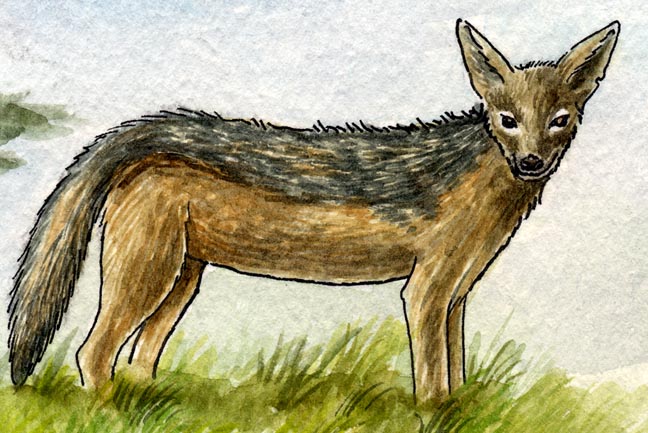
Golden jackals are found in north and east Africa, the Middle East and in some places in Europe.
Golden jackals are found on savannah and dry scrublands.
They are small members of the dog family, measuring about three feet long and weighing up to 35 pounds.
They make loud yips and howls to communicate with family members. They are active mostly at night (nocturnal). Jackals have one mate for life.
They live in pairs or little family groups hunting small animals, newborn gazelles or feeding on dead animals (scavengers). They will eat fruit and plants too.
Predators are leopards, hyenas and eagles.
The female is pregnant for 9 weeks (gestation) giving birth to about 4 pups late in the year.
They live about 10 years in the wild. They are listed as Lower Risk - least concern.
Kingdom: Animalia
Phylum: Chordata
Subphylum: Vertebrata
Class: Mammalia
Order: Carnivora
Suborder: Caniformia
Family: Canidae
Genus: Canis
Species: Canis aureus
When you research information you must cite the reference. Citing for websites is different from citing from books, magazines and periodicals. The style of citing shown here is from the MLA Style Citations (Modern Language Association).
When citing a WEBSITE the general format is as follows.
Author Last Name, First Name(s). "Title: Subtitle of Part of Web Page, if appropriate." Title: Subtitle: Section of Page if appropriate. Sponsoring/Publishing Agency, If Given. Additional significant descriptive information. Date of Electronic Publication or other Date, such as Last Updated. Day Month Year of access < URL >.
Amsel, Sheri. "Jackal (Golden)" Exploring Nature Educational Resource ©2005-2024. March 25, 2024
< http://www.exploringnature.org/db/view/341 >