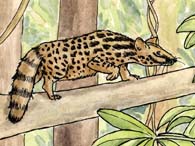
The genet lives in Africa.
The genet lives in many habitats of Africa from forest and scrubland to savannah and desert.
Their spotted fur acts as camouflage. They have a long striped tail and are very cat-like in their ability to stalk and climb trees after prey. They actually purr when stalking prey! In fact they are not cats, but actually are in the same family as the mongoose. They can get as large as 6 pounds and as long as 3 feet, though almost half of that length is tail.
They are nocturnal and travel alone (solitary).
They are mostly carnivores, hunting small animals and insects, but also will eat fruit.
Their main predator is man.
Every year they have two litters, with two or three young each. Females are pregnant for 2.5 months (about 75 days) (gestation).
They live about 8 years in the wild. They are listed as Lower Risk - Least Concern.
Kingdom: Animalia
Phylum: Chordata
Subphylum: Vertebrata
Class: Mammalia
Order: Carnivora
Suborder: Feliformia
Family: Viverridae
Subfamily: Viverrinae
Genus: Genetta
Species: Genetta angolensis
When you research information you must cite the reference. Citing for websites is different from citing from books, magazines and periodicals. The style of citing shown here is from the MLA Style Citations (Modern Language Association).
When citing a WEBSITE the general format is as follows.
Author Last Name, First Name(s). "Title: Subtitle of Part of Web Page, if appropriate." Title: Subtitle: Section of Page if appropriate. Sponsoring/Publishing Agency, If Given. Additional significant descriptive information. Date of Electronic Publication or other Date, such as Last Updated. Day Month Year of access < URL >.
Amsel, Sheri. "Genet" Exploring Nature Educational Resource ©2005-2024. March 26, 2024
< http://www.exploringnature.org/db/view/335 >