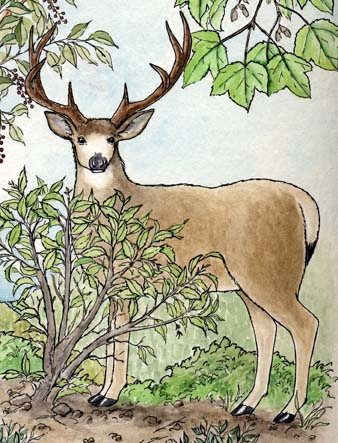
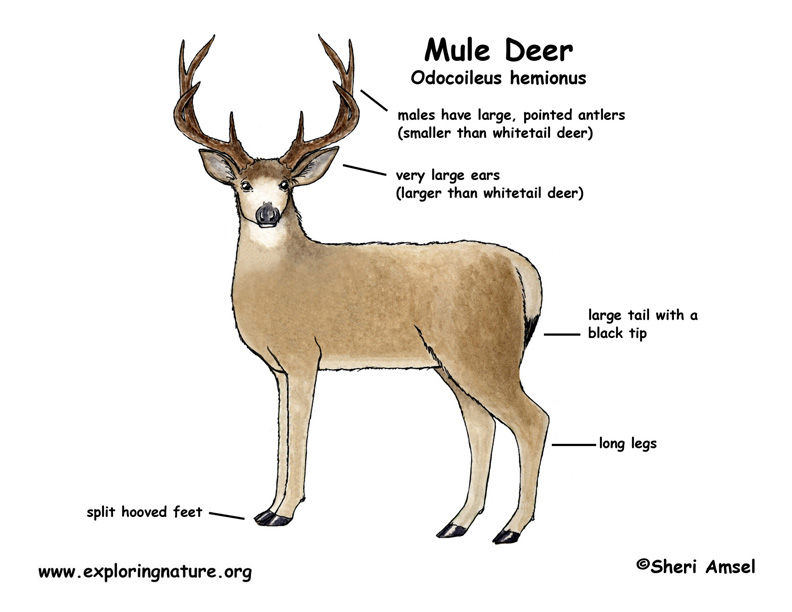
Mule deer live throughout the Western U.S. including the deserts in the Southwest.
They are often found in dry open country and rocky hillsides.
They are a grayer brown than white-tailed deer, to blend into their dry habitat. They have a smaller tail with a black tip. They do not raise it like a whitetail does. They have larger ears than whitetail’s (like a mule’s) and smaller antlers.
They have a high bouncing run (gate).
They are browsers. This means they eat twigs and buds. But they also will east grass, mushrooms and even cactus.
Predators are mountain lions. Fawns may be taken by coyotes, bears, or wolves.
They are pregnant for about 6.5 months (gestation). They usually have twins in the spring.
They live up to 10 years in the wild. They are not threatened.
Kingdom: Animalia
Phylum: Chordata
Subphylum: Vertebrata
Class: Mammalia
Order: Artiodactyla
Family: Cervidae
Subfamily: Capreolinae
Genus: Odocoileus
Species: Odocoileus hemionus
When you research information you must cite the reference. Citing for websites is different from citing from books, magazines and periodicals. The style of citing shown here is from the MLA Style Citations (Modern Language Association).
When citing a WEBSITE the general format is as follows.
Author Last Name, First Name(s). "Title: Subtitle of Part of Web Page, if appropriate." Title: Subtitle: Section of Page if appropriate. Sponsoring/Publishing Agency, If Given. Additional significant descriptive information. Date of Electronic Publication or other Date, such as Last Updated. Day Month Year of access < URL >.
Amsel, Sheri. "Deer (Mule)" Exploring Nature Educational Resource ©2005-2024. March 25, 2024
< http://www.exploringnature.org/db/view/327 >