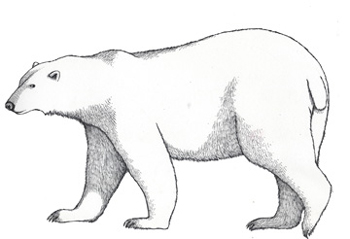
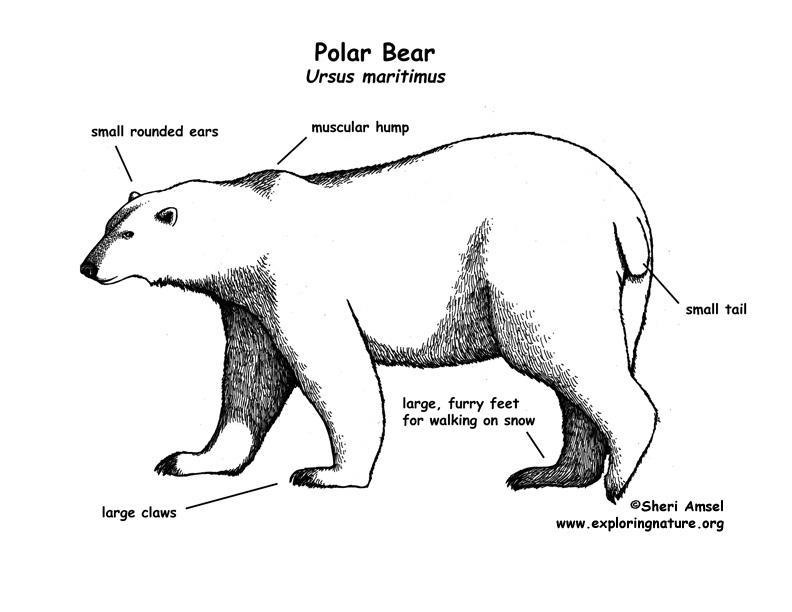
Polar bears are found across northern Canada, Alaska, Greenland and even Russia.
Polar bears live on the freezing polar ice pack of the arctic.
They have more than 4 inches of fat called “blubber.” This protects them from the extreme cold. Males weigh from 700 - 1,500 pounds, while females are only 300 - 600 pounds. They have huge front paws they use for swimming. Their skin is black and though their fur looks white, polar bears are now known to have transparent fur. This interesting adaptation allows light to be refracted on the clear strands giving it a white appearance. In the summer months their fur looks yellow or grayish-brown. Their fur, which can even be found on the soles of their feet, helps protect them from the Arctic's extreme weather.
They will attack and eat humans.
They eat mostly seals, making them the only pure meat eater (carnivore) of all the bears in North America.
The only predator that kills polar bears is man, though one polar bear may kill another.
Females have 2 cubs in their winter den. Polar bear cubs nurse on milk for more than a year and a half. This helps them survive the cold. More than half of all cubs die in their first year.
If they get past the first year, they can live up to 25 years in the wild. They are listed as a "vulnerable" species.
Kingdom: Animalia
Phylum: Chordata
Subphylum: Vertebrata
Class: Mammalia
Order: Carnivora
Suborder: Caniformia
Family: Ursidae
Genus: Ursus
Species: Ursus maritimus
When you research information you must cite the reference. Citing for websites is different from citing from books, magazines and periodicals. The style of citing shown here is from the MLA Style Citations (Modern Language Association).
When citing a WEBSITE the general format is as follows.
Author Last Name, First Name(s). "Title: Subtitle of Part of Web Page, if appropriate." Title: Subtitle: Section of Page if appropriate. Sponsoring/Publishing Agency, If Given. Additional significant descriptive information. Date of Electronic Publication or other Date, such as Last Updated. Day Month Year of access < URL >.
Amsel, Sheri. "Bear (Polar)" Exploring Nature Educational Resource ©2005-2024. December 13, 2024
< http://exploringnature.org/db/view/314 >