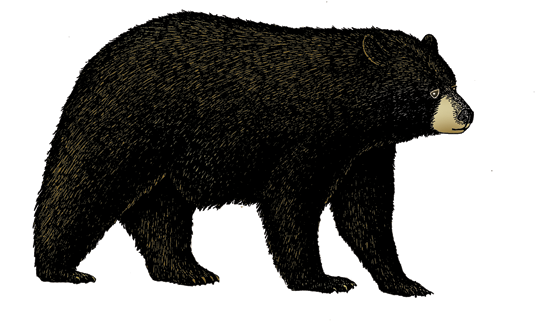
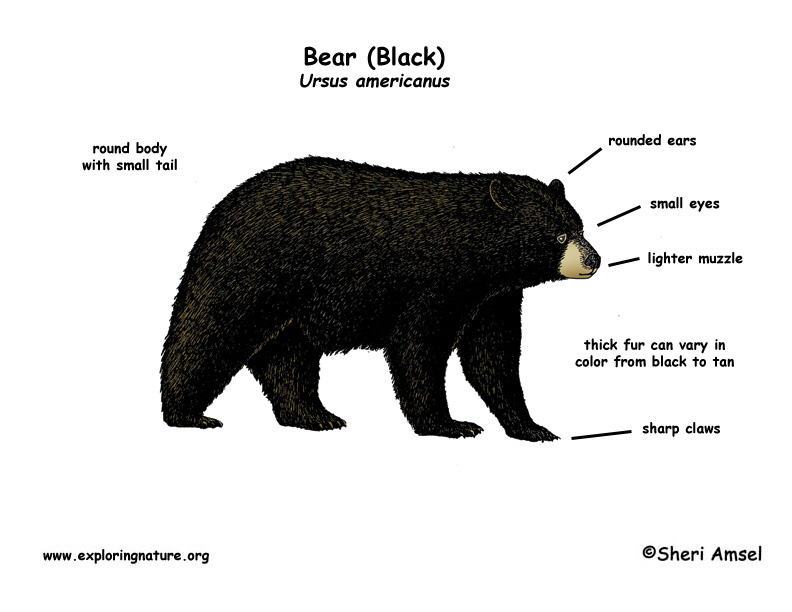
The black bears of North America live in many places.
They like old forests, swamps and scrubby places where fires have burned all the trees.
Their fur can be many colors from tan to brown to black. Male black bears weigh about 300 pounds. Females weigh about 150 pounds. The largest black bears reach up to 600 pounds.
Black bears are active mostly at night (nocturnal), but are often seen at dawn or dusk (crepuscular). They spend the winter in a den sleeping (hibernating). During hibernation, they don't eat or drink and lose much of their body fat.
They eat plants and animals (omnivores). They eat small mammals, fruits, nuts, roots and insects.
The only predator that kills black bears is man, though one black bear may kill another.
Females have 1-3 babies called cubs. They are born in January or February, while in their den. Female black bears are pregnant for about 7.5 months (gestation). The babies nurse on milk for about 8 months. They stay with their mother through their second winter being taught to hunt for food and survive. That second spring, when they are about a year and half, she will chase them off to go out on their own.
They live up to 30 years in the wild. The males usually live shorter than the females. They are not a threatened species.
Kingdom: Animalia
Phylum: Chordata
Subphylum: Vertebrata
Class: Mammalia
Order: Carnivora
Suborder: Caniformia
Family: Ursidae
Genus: Ursus
Species: Ursus americanus
When you research information you must cite the reference. Citing for websites is different from citing from books, magazines and periodicals. The style of citing shown here is from the MLA Style Citations (Modern Language Association).
When citing a WEBSITE the general format is as follows.
Author Last Name, First Name(s). "Title: Subtitle of Part of Web Page, if appropriate." Title: Subtitle: Section of Page if appropriate. Sponsoring/Publishing Agency, If Given. Additional significant descriptive information. Date of Electronic Publication or other Date, such as Last Updated. Day Month Year of access < URL >.
Amsel, Sheri. "Bear (Black)" Exploring Nature Educational Resource ©2005-2024. March 25, 2024
< http://www.exploringnature.org/db/view/312 >