There are many kinds of walking sticks all over the world. Some are found in rain forests and some are found in forests with seasons like those in the U.S. and Canada.
They are found in leafy forests.
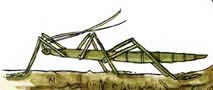
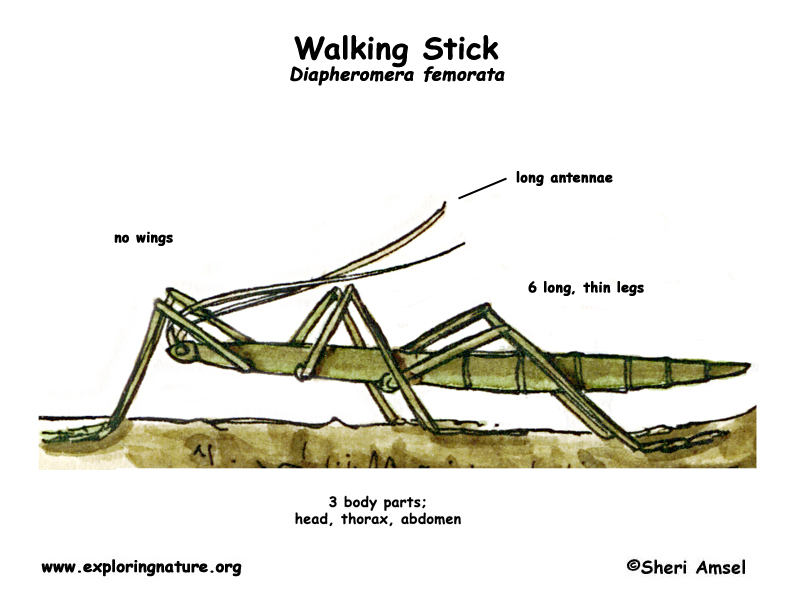
Thin, brownish-green with twig-like body and long, thin legs that makes them look like twigs. No wings, long antennae.
Blends well on trees making it hard to detect. Active at night.
They eat tree leaves. Can cause damage.
The stick insect egg or ova has a very characteristic form. It has a very hard and tough shell. There is a cap at one end, called a "capitulum," which the baby insect pushes off when it comes out of the egg case. In general, most stick insect eggs look like seeds. Some ants will even pick them up and keep them as if they are real seeds. Most stick insects just drop their eggs onto the ground.
Domain: Eukarya
Kingdom: Animalia
Phylum: Arthropoda
Class: Insecta
Order: Phasmatodea
Family: Diapheromerinae
Genus: Diapheromera
Species: D. femorata
When you research information you must cite the reference. Citing for websites is different from citing from books, magazines and periodicals. The style of citing shown here is from the MLA Style Citations (Modern Language Association).
When citing a WEBSITE the general format is as follows.
Author Last Name, First Name(s). "Title: Subtitle of Part of Web Page, if appropriate." Title: Subtitle: Section of Page if appropriate. Sponsoring/Publishing Agency, If Given. Additional significant descriptive information. Date of Electronic Publication or other Date, such as Last Updated. Day Month Year of access < URL >.
Amsel, Sheri. "Walking Stick" Exploring Nature Educational Resource ©2005-2024. March 25, 2024
< http://www.exploringnature.org/db/view/254 >