They are found in the eastern part of Southern Canada and the U.S.
They live in wet forests near a pond, lake or wetland.
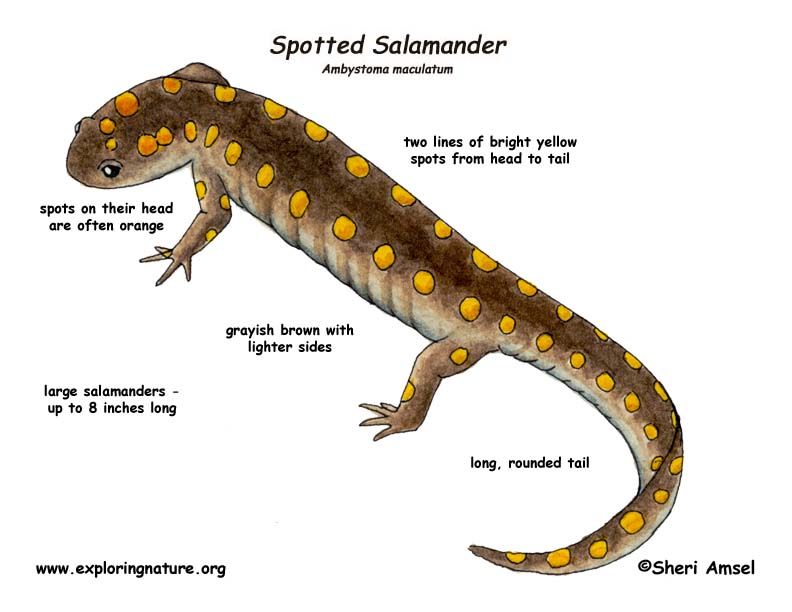
They are one of the largest salamanders reaching 8 inches in length. They are dark grayish-brown with two rows of bright yellow spots running down their body. The spots on their head are often bright orange. Their sides are often lighter in color.
They are shy salamanders, living under logs, rocks or the leaf litter on the forest floor. They are seen mostly after a hard spring rain.
They eat insects, worms and other small animals found on the forest floor.
They protect themselves from predators by having a toxin that comes out on their skin from glands that makes them taste bad. Humans should wash their hands after handling one.
They lay about 200 eggs in a jelly like mass that they attach to an anchored plant underwater, after the first warm spring rain.
Kingdom: Animalia
Phylum: Chordata
Subphylum: Vertebrata
Class: Amphibia
Order: Caudata
Family: Ambystomatidae
Genus: Ambystoma
Species: A. maculatum
When you research information you must cite the reference. Citing for websites is different from citing from books, magazines and periodicals. The style of citing shown here is from the MLA Style Citations (Modern Language Association).
When citing a WEBSITE the general format is as follows.
Author Last Name, First Name(s). "Title: Subtitle of Part of Web Page, if appropriate." Title: Subtitle: Section of Page if appropriate. Sponsoring/Publishing Agency, If Given. Additional significant descriptive information. Date of Electronic Publication or other Date, such as Last Updated. Day Month Year of access < URL >.
Amsel, Sheri. "Salamander (Spotted)" Exploring Nature Educational Resource ©2005-2024. March 25, 2024
< http://www.exploringnature.org/db/view/57 >