They are found in the Mojave, Sonoran and Chihuahuan deserts in southwestern Utah, southern Nevada, southeastern California, western Arizona and southwestern New Mexico into Mexico.
They live in desert and dry areas with gravel and sandy soils and bushy brush. They often hide under rocks and in burrows or holes.
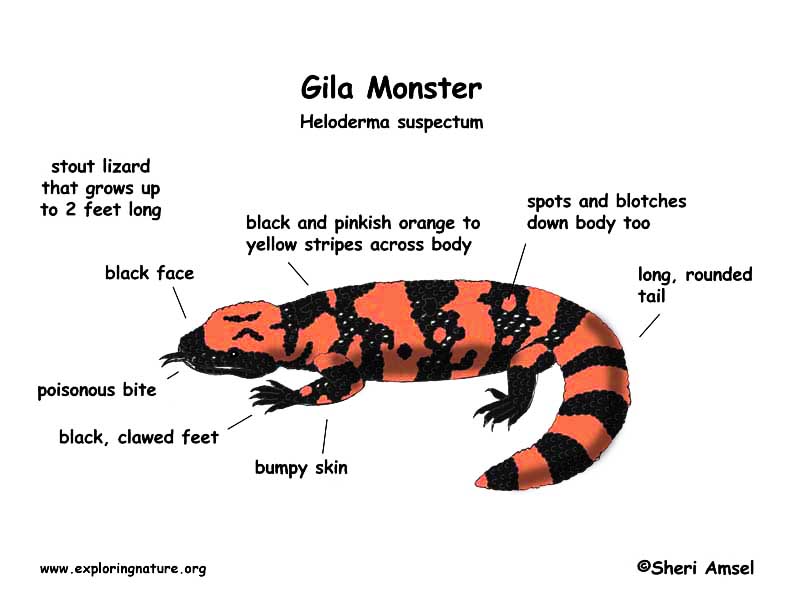
The gila monster is a stout lizard that grows up to 2 feet long. It has a black face, feet and stripes across its body with pinkish orange to yellow stripes, spots and blotches down its body too. Its skin is bumpy. It has a poisonous bite that will make its prey sleepy and sluggish. It is usually not strong enough to kill a person.
They are active at night (nocturnal).
They eat small birds, rodents, eggs, and other lizards. In the winter, they live off the fat stored in the tail.
They have few predators except man.
They mate all summer. The female lays 3 - 5 eggs in sandy soils, burrows or under rocks in the fall or winter.
Kingdom: Animalia
Phylum: Chordata
Subphylum: Vertebrata
Class: Reptilia
Order: Squamata
Suborder: Autarchoglossa
Family: Helodermatidae
Genus: Heloderma
Species: H. suspectum
When you research information you must cite the reference. Citing for websites is different from citing from books, magazines and periodicals. The style of citing shown here is from the MLA Style Citations (Modern Language Association).
When citing a WEBSITE the general format is as follows.
Author Last Name, First Name(s). "Title: Subtitle of Part of Web Page, if appropriate." Title: Subtitle: Section of Page if appropriate. Sponsoring/Publishing Agency, If Given. Additional significant descriptive information. Date of Electronic Publication or other Date, such as Last Updated. Day Month Year of access < URL >.
Amsel, Sheri. "Gila Monster" Exploring Nature Educational Resource ©2005-2024. March 25, 2024
< http://www.exploringnature.org/db/view/508 >