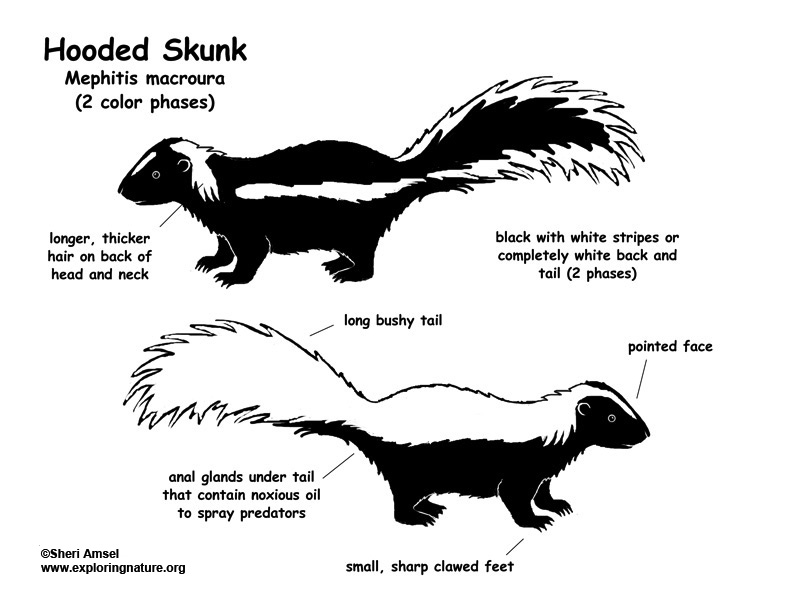
They are found In Mexico and some southwestern states in the U.S.
They live in scrubby grasslands, rocky areas and along rocky streams.
They are mostly black with white stripes down the back onto the tail, similar to the striped skunk but much smaller (less than 2 pounds, about 2 feet long). They also have more white on the back, longer fur, and a longer tail. They have a long ruff of fur on the back of the head and neck (where they got their name), though their color patterns can vary. Like the striped skunk, they have small, clawed feet, a pointed face. They have toxic oil glands under the tail (anal glands) which which they can spray enemies.
They are nocturnal. They are shyer than other skunk species and will try to escape rather than turn and spray unless cornered.
They eat insects and some cactus and small mammals.
They are killed by bobcats, owls, and humans.
Females give birth from February through March and have about 3 kits.
Kingdom: Animalia
Phylum: Chordata
Class: Mammalia
Order: Carnivora
Family: Mephitidae
Genus: Mephitis
Species: M. macroura
When you research information you must cite the reference. Citing for websites is different from citing from books, magazines and periodicals. The style of citing shown here is from the MLA Style Citations (Modern Language Association).
When citing a WEBSITE the general format is as follows.
Author Last Name, First Name(s). "Title: Subtitle of Part of Web Page, if appropriate." Title: Subtitle: Section of Page if appropriate. Sponsoring/Publishing Agency, If Given. Additional significant descriptive information. Date of Electronic Publication or other Date, such as Last Updated. Day Month Year of access < URL >.
Amsel, Sheri. "Skunk (Hooded)" Exploring Nature Educational Resource ©2005-2024. March 25, 2024
< http://www.exploringnature.org/db/view/458 >