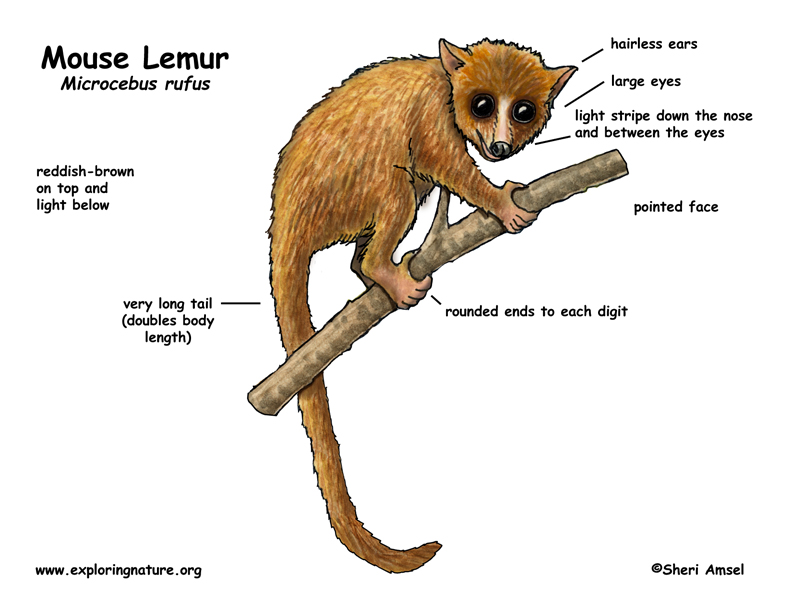
They are found on the island of Madagascar.
They live in wet forests.
They are very small, weighing less than 3 ounces. They have big eyes and a long tail. They have reddish fur and are lighter underneath. Their tails get darker at the end.
They have a call that sounds like the chirping of a bird. Males live alone except to mate, but females will live together in little groups. They are active at night (nocturnal). During the day they sleep in nests made of leaves in tree hollows.
They eat insects, small animals, and fruit.
They are eaten by snakes, hawks and owls.
Females are pregnant for about 2 months (gestation) and have 2 babies.
Unknown lifespan. They are listed as Lower Risk - least concern.
Kingdom: Animalia
Phylum: Chordata
Subphylum: Vertebrata
Class: Mammalia
Order: Primates
Suborder: Strepsirrhini
Family: Cheirogaleidae
Genus: Microcebus
Species: Microcebus murinus
When you research information you must cite the reference. Citing for websites is different from citing from books, magazines and periodicals. The style of citing shown here is from the MLA Style Citations (Modern Language Association).
When citing a WEBSITE the general format is as follows.
Author Last Name, First Name(s). "Title: Subtitle of Part of Web Page, if appropriate." Title: Subtitle: Section of Page if appropriate. Sponsoring/Publishing Agency, If Given. Additional significant descriptive information. Date of Electronic Publication or other Date, such as Last Updated. Day Month Year of access < URL >.
Amsel, Sheri. "Lemur (Mouse)" Exploring Nature Educational Resource ©2005-2024. March 25, 2024
< http://www.exploringnature.org/db/view/447 >