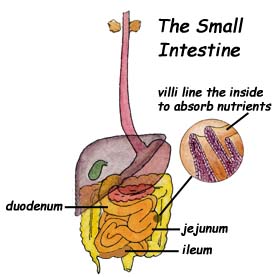
The small intestine is about 6 feet long (2 meters) in an adult*, a hollow tube that twists and turns in a jumbled mass tucked inside the curve of the large intestine. It is divided into 3 parts: the duodenum, the jejunum and the ileum. * If you could relax all the muscle of the small intestine you can stretch it out to about 20 feet long (6 meters).
The small intestine is where digestion is finished up and all the food nutrients are taken off (absorbed) into the blood. The digested food from the stomach (chyme) empties into the duodenum. It is here that the pancreas gland sends its pancreatic juice into the food. Also bile made in the liver and stored in the gall bladder enters here. Bile helps break down fats. Inside the small intestine, the lining has tiny fingers called villi. Villi absorb the nutrients from the food passing through the small intestine. The nutrients pass into the capillaries to go to where the body needs them.
Everything Kids HUMAN BODY BOOK
Learn about the body's systems: digestive, circulatory, respiratory, skeletal, muscular, nervous, endocrine, reproductive and your protective integument (your skin!) This book breaks down the human body and explains its parts and how it works in language a middle school student can understand -- or anyone who is interested in how our amazing bodies work. Also learn fun facts about the body, important vocabulary, interesting exercises and health tips and even do more than 30 body puzzles. Have fun on this 160-page anatomy adventure!