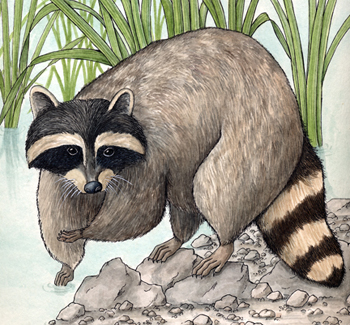
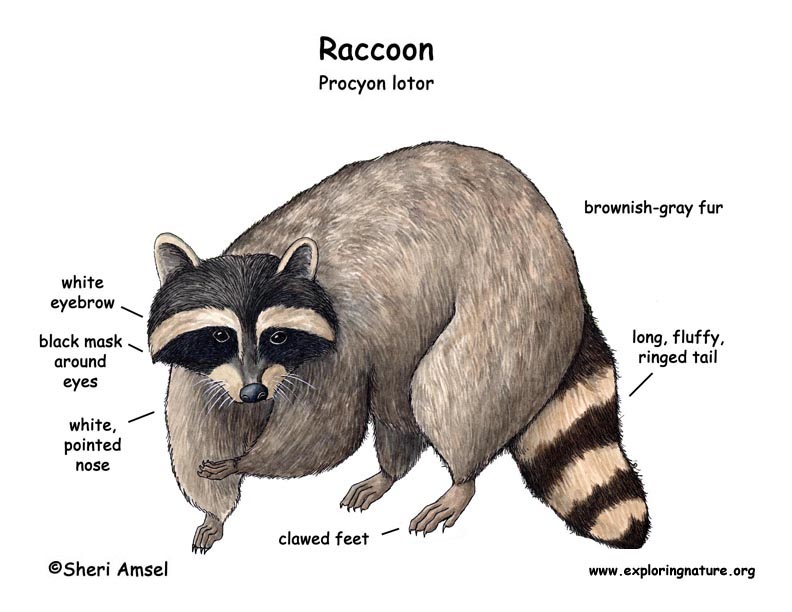
Raccoons are found throughout the western hemisphere from Canada to Argentina. They have also been introduced to Europe and Asia.
Raccoons live in woodlands near water in the wild, but have become at home in farmlands, neighborhoods and cities. They den in trees and sometimes in abandoned burrows or caves. They will also den in attics, barns, and garages.
Raccoons are 4-feet long including their tails and in the wild weigh from 15-30 pounds. Raccoons in the north tend to weigh more. Urban raccoons feeding on trash can reach 60 pounds! They have a ringed tail and black mask on their face.
Raccoons are active year round at night (nocturnal), but can be seen at dawn or dusk.
Raccoons are omnivores and will eat frogs, crayfish, fish, birds, eggs, fruits, nuts, grains, small mammals and insects.
Predators include mountain lions, bobcats, wolves, red foxes, coyotes, fishers, owls and man.
Females are pregnant for 2 months (gestation) and have 3-7 young in the early spring.
They can live more than 10 years in the wild, though most live just 2-3. They are not threatened.
Kingdom: Animalia
Phylum: Chordata
Subphylum: Vertebrata
Class: Mammalia
Order: Carnivora
Suborder: Caniformia
Family: Procyonidae
Genus: Procyon
Species: Procyon lotor
When you research information you must cite the reference. Citing for websites is different from citing from books, magazines and periodicals. The style of citing shown here is from the MLA Style Citations (Modern Language Association).
When citing a WEBSITE the general format is as follows.
Author Last Name, First Name(s). "Title: Subtitle of Part of Web Page, if appropriate." Title: Subtitle: Section of Page if appropriate. Sponsoring/Publishing Agency, If Given. Additional significant descriptive information. Date of Electronic Publication or other Date, such as Last Updated. Day Month Year of access < URL >.
Amsel, Sheri. "Raccoon" Exploring Nature Educational Resource ©2005-2024. March 25, 2024
< http://www.exploringnature.org/db/view/364 >