They breed in southern Canada through the U.S. and south through South America and the Caribbean. They spend the winter in the southern U.S. through South America.
They live in open areas mixed with forests.
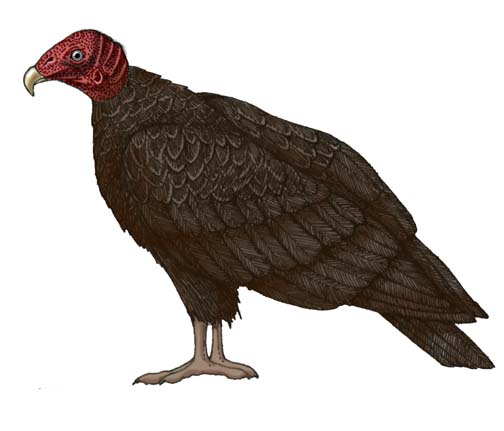
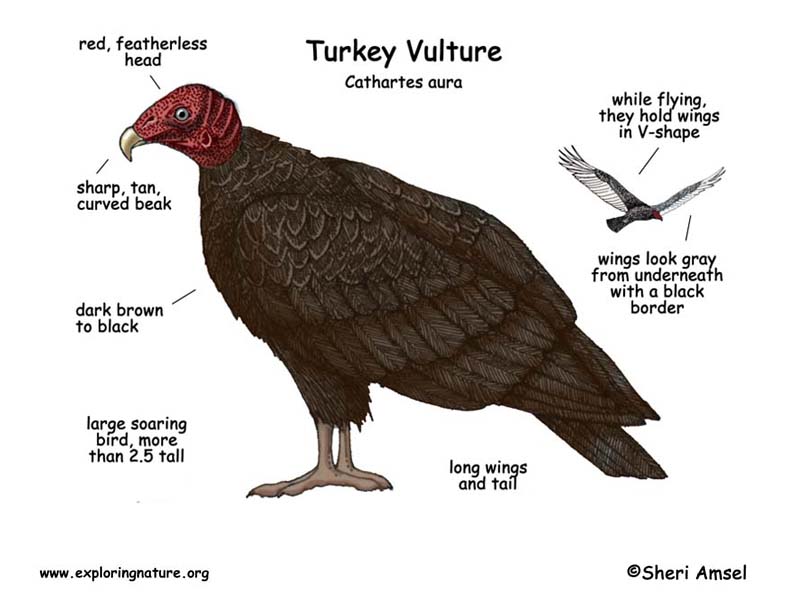
They are a large soaring bird, more than 2.5 tall with long wings and tail. They are mostly dark brown to black with a red, featherless head. While they are flying, they hold their wings in a V shape. Their wings look gray from underneath with a black border. Males and females look the same.
They use their great sense of smell to find dead animals (carrion). The Turkey Vulture is usually alone, unlike the Black Vulture, which hunts for food in a group.
They eat dead animals (carrion), but also may eat insects, small animals, and even fruit.
They don’t build a nest, but lay eggs right on the ground in a cave, rock pile, empty burrows, or hollow logs. Female lays 1 - 3 white eggs with dark spots.
Kingdom: Animalia
Phylum: Chordata
Subphylum: Vertebrata
Class: Aves
Order: Falconiformes
Family: Cathartidae
Genus: Cathartes
Species: C. aura
When you research information you must cite the reference. Citing for websites is different from citing from books, magazines and periodicals. The style of citing shown here is from the MLA Style Citations (Modern Language Association).
When citing a WEBSITE the general format is as follows.
Author Last Name, First Name(s). "Title: Subtitle of Part of Web Page, if appropriate." Title: Subtitle: Section of Page if appropriate. Sponsoring/Publishing Agency, If Given. Additional significant descriptive information. Date of Electronic Publication or other Date, such as Last Updated. Day Month Year of access < URL >.
Amsel, Sheri. "Vulture (Turkey)" Exploring Nature Educational Resource ©2005-2024. March 25, 2024
< http://www.exploringnature.org/db/view/103 >