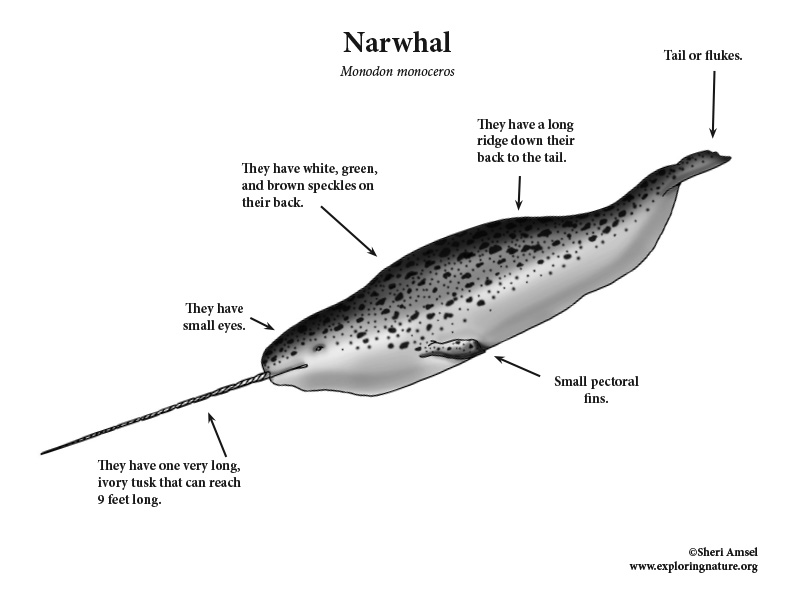
They are found in waters around the Arctic circle off the coasts of North America and Russia, also in Hudson Bay, and off the east coast of Greenland.
They live in the deep waters of ice packed oceans, bays and fjords.
They grow up to 20 feet long and can weight over 2,000 pounds (a ton). They have white, green and brown speckles and a long ridge down their backs to their tail (flukes). They have small eyes. Males have one, long, ivory tusk that can reach 9 feet long. New research suggests this tusk may have a sensory role for the whale — it may help them sense things in the water.
They travel in separate groups: females with young, young males, and groups of mature males. These groups can grow to hundreds or more when they are traveling or feeding. They are often seen together with beluga whales. They travel (migrate) seasonally. They can be trapped in the ice and die without an air hole to breathe through.
They eat fish, shrimp, and squid. They hunt prey in dark, deep waters using a kind of radar called echolocation.
They are hunted by sharks, killer whales, and polar bears.
Females are pregnant for 10-16 months (gestation). They have 1 calf (sometimes twins) every 2-3 years. Calves are brown.
They can live up to 50 years.
Kingdom: Animalia
Phylum: Chordata
Subphylum: Vertebrata
Class: Mammalia
Order: Cetacea
Suborder: Odontoceti
Family: Monodontidae
Genus: Monodon
Species: Monodon monoceros
When you research information you must cite the reference. Citing for websites is different from citing from books, magazines and periodicals. The style of citing shown here is from the MLA Style Citations (Modern Language Association).
When citing a WEBSITE the general format is as follows.
Author Last Name, First Name(s). "Title: Subtitle of Part of Web Page, if appropriate." Title: Subtitle: Section of Page if appropriate. Sponsoring/Publishing Agency, If Given. Additional significant descriptive information. Date of Electronic Publication or other Date, such as Last Updated. Day Month Year of access < URL >.
Amsel, Sheri. "Narwhal" Exploring Nature Educational Resource ©2005-2024. March 25, 2024
< http://www.exploringnature.org/db/view/413 >